

Oil Burner Testing
Oil burner testing plays an important role in evaluating the fire resistance and performance of aircraft materials and components exposed to severe flame conditions. ACES provides in-house oil burner testing for a range of aviation applications, including aircraft seat cushions and fire-blocking materials, cargo liners, acoustic insulation, powerplant firewalls, and fuel-system components. With experienced technicians, engineering support, and FAA DER expertise available within the same organization, ACES can help customers coordinate test planning, specimen preparation, testing, documentation, and certification support efficiently from initial evaluation through final compliance.
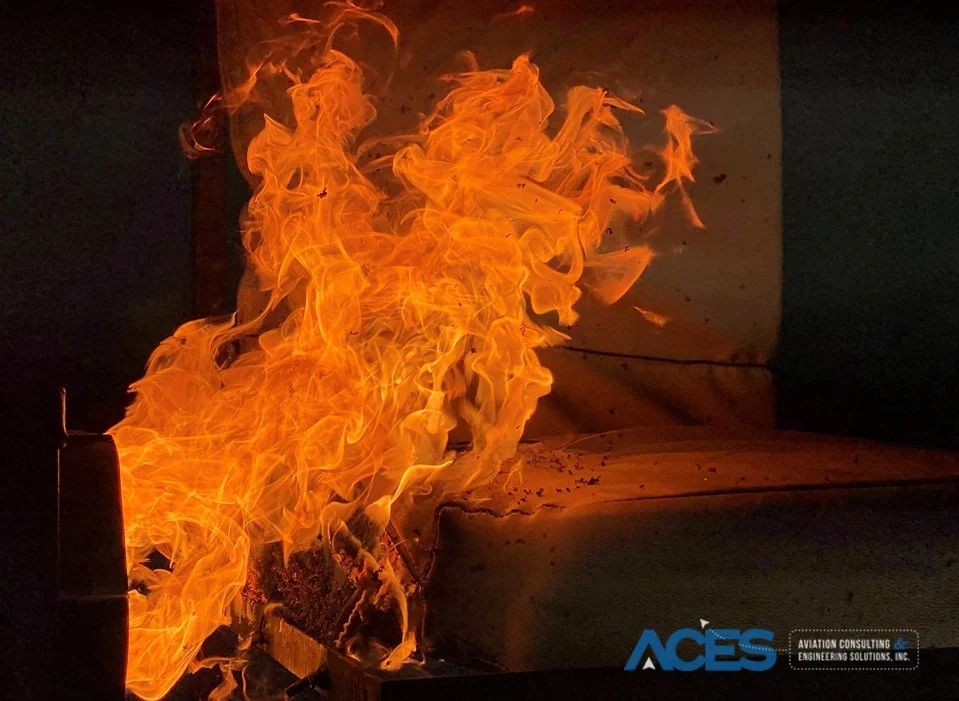
The Oil Burner Test for aircraft seat cushions, commonly referred to as the Fireblock Test, evaluates the weight loss of the cushion assembly and the char length produced on the dress cover and underlying foam.
The test is used to demonstrate compliance with 14 CFR §§ 25.853(c) and 29.853(b).
Seat Cushions Commonly Requiring Testing
- Back cushions
- Bottom cushions
- Headrest cushions
- Footrest and leg-rest cushions
In addition to oil burner testing, applicable seat cushion materials are required to undergo 12-second vertical testing to support compliance with 14 CFR §§ 25.853(a) and 29.853(a).
Applicable CFRs
Learn MoreOil burner testing for cargo liners evaluates the flame-penetration resistance of aircraft cargo-compartment lining materials when exposed to a high-intensity open flame.
Testing is used to support compliance with 14 CFR § 25.855(c).
Components Commonly Tested
- Cargo ceilings
- Cargo walls
- Cargo liners
Applicable CFRs
Learn MoreOil burner testing of thermal and acoustic insulation evaluates the material's ability to resist burnthrough when exposed to a high-intensity flame.
Testing is used to support demonstration of compliance with 14 CFR § 25.856(b).
Applicable CFRs
Learn MoreOil burner testing for powerplant firewalls evaluates the ability of firewall assemblies to resist flame propagation and flame penetration under severe fire exposure.
Testing can support demonstration of compliance with 14 CFR §§ 25.867, 25.865, 25.1191 and 25.1193.